tiistai 31. maaliskuuta 2015

Why companies use media agencies?

What is the process of interaction between a client company and a media agency?

No two media agencies have exactly the same work flow process, but according to multiple sources they do follow usually the same pattern:


  1. Receiving a brief or a project assignment from the client
    1. The clients marketing department details their marketing and business objectives to the agency
  2. Strategic development. Seek understanding of the key group they need to influence.
    1. Can be done for example talking with the customers, conducting questionnaires and market research.
    2. Research consuming and media usage behavior of the key target group
  3. Working closely with the client to develop and idea and a media plan for them to use


How do media agencies make use of big data to get consumer insight? 



Using Google Trends can be used easily to get to know trending topics and to know how often a specific searches are made in google. With this tool marketers and media agencies can easily see what is trending in different parts of the world at the moment.

Using digital information in defining an ICP (Ideal Customer Profile). Many sites give an option to sign in with your social media account to define your age, gender nationality, etc. This information is then linked to your behavior on the site, and when this kind of information is collected from all the users using the site, the company can easily define their ideal customers.

Media agencies can also use data collected by another party, such as Facebook. This year researchers from the University of Cambridge and Stanford university did a research that concluded that Facebook can actually predict our personality and behavior better than our family and friends. This is why using Facebook advertising can be really effective.


What is  PESO?
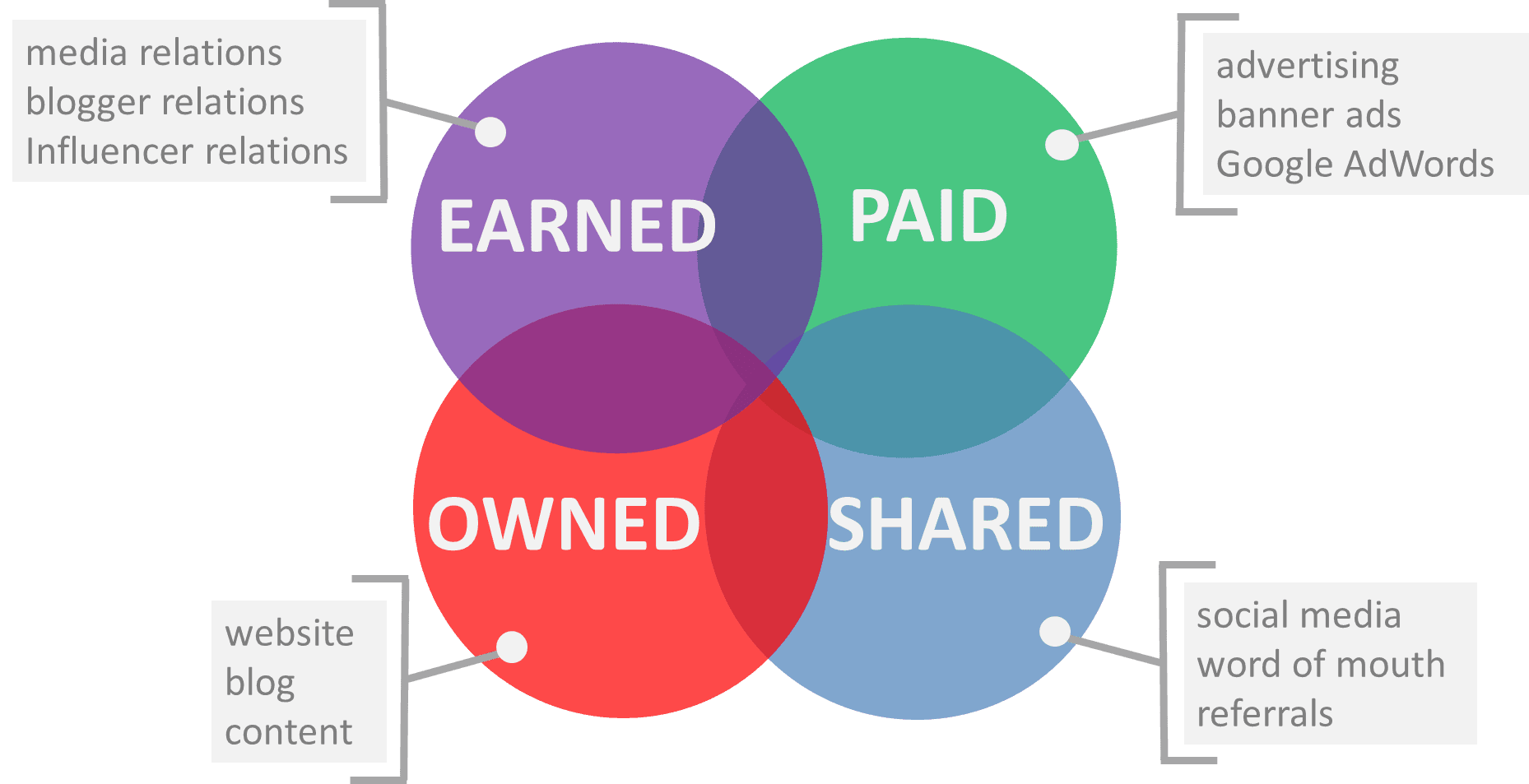


Paid Media: Includes media a company paid for, like google AdWords, Facebook sponsored posts, outdoor advertising, website banners, TV commercials, etc. As paid media costs money, it should be well planned and implemented. Using accurate key words and content. Paid media is mostly used to gain visibility and attract new customers and strangers.

Owned Media: Includes company websites, blogs and other content created by the company like news letters. Owned media is mostly used to keep control of the brand and to inform and attract existing customers.

Earned Media: Includes social media reviews, blog posts, written articles. Companies can hire a PR agency to create an ad campaign that becomes viral and people start to talk and write about it online. These articles, blog posts etc. resulting from the campaign are called earned media. 

Shared Media: Includes social media activity and the sharing happening there. Can also be a marketing campaign that includes customers or fans, for example to pick a new flavor etc. for a upcoming product. Gets existing customers, followers and fans to share and do advertising on behalf of the company


Programmatic advertising article:
http://digiday.com/platforms/what-is-programmatic-advertising/


Sources:

http://www.mediacom.com/en/what-we-do/our-industry/media-agencies/how-does-a-media-agency-work.aspx

http://www.marketing.org.au/?i=EYK/Z0vgN6Y=&t=jZS6ngCVPug=

http://blogs.salesforce.com/company/2014/11/5-ways-marketers-can-actually-use-big-data-gp.html

http://www.forbes.com/sites/danielnewman/2015/02/24/big-data-why-facebook-knows-us-better-than-our-therapist/

http://news.stanford.edu/news/2015/january/personality-computer-knows-011215.html

http://www.matternow.com/news-views/prwhiteboard/whats-the-difference-between-paid-owned-and-earned-media/

tiistai 17. maaliskuuta 2015

PBL 6: What does a communication plan involve?

Definition of communication plan by business dictionary:

Step by step process to ensure that the intended message is received, understood, and acted upon by the recipient. It involves: determining the objectives, choosing the audience, and selecting appropriate channels to reach them.

Different communication models

According to wisegeek.com, there are typically three different kinds of communication plans

1.  Internal business communication plan
- Only for stakeholders inside the company, like owners, managers and employees. Different communication methods in this plane could be telephone, email, conferences and face-to-face meetings. Might contain sensitive information.

2. External business communication plan
-Opposite of internal, used by external stakeholders who need information.

3. Crisis communication plan
-Only used when a crisis occurs to inform stakeholders about the crisis, how the company is going to handle it, and maintain normal business operations.


Trends in communication

Business communication follows normal communication trends, such as social media and instant messaging, but on top of that it also has its own trends. Some of the trends mentioned online are:

  • BYOD (Bring Your Own Device)
    • Many people work and need to access company information remotely, so communication should be seamless with all devices, such as smart phone, tablet, computer.
  • JOC (Join Our Cloud)
    • Follows BYOD, as companies are not device centric, they focus on improving their platforms.
  • Transition from print do digital
  • Videos in internal communication
    • Can be watched when ever. Many companies taking a YouTube kind of approach with a video library with the possibility to comment, tag, share and upload.

How to measure success of communication plan

How to evaluate a communication plan:

  • Transmission
    • Was the information received by the right party?
      • verifying that the message was received.
  • Understanding
    • Was it interpreted the way the sender wanted?
      • Avoid "broken phone" or "grape vine" effect
  • Satisfaction
    • Where the receivers/customers satisfied?
      • Timing, mode of communication
Some experts also say that communication should be 
  • Minimalist (As short as possible without losing important things)
  • Automated if possible (Easier to monitor and share)
  • Local (meet the needs of specific target audience)

Sources:
http://www.isae.org/wp-content/uploads/2013/06/Crisis-Communications-795x1024.jpg?821bdd
http://www.wisegeek.com/what-are-the-different-types-of-business-communication-plans.htm
http://www.newsweaver.com/5-internal-communication-trends-watch-2015/#.VQiKsmSUeso
http://www.itbusinessedge.com/slideshows/top-five-business-communications-trends-for-2014-03.html
http://www.businessdictionary.com/definition/communications-planning.html#ixzz3Ug3AEVZE
http://www.commpro.biz/marketing/integrated-marketing/planning-success-14-top-pr-integrated-marketing-communications-trends-2014/
http://www.medscape.com/viewarticle/744865_7
http://toolkit.pellinstitute.org/evaluation-guide/communicate-improve/evaluate-your-communication-efforts/

tiistai 10. maaliskuuta 2015

PBL 5: How to create a brand strategy?

What kind of brand strategies exist 


From the website cpfq.com I could find the following different brand strategies:

New model strategy
a system to promote both products and services by way of a new brand. Used a lot for example by mobile phone manufacturers, such as Apple and Samsung (iPhone & Galaxy)

Line extension method

A method where a new variant of an existing product is added, for example shampoo manufacturer may have different shampoos for dandruff, greasy hair, etc.

Brand extension system

A method where a brand with a well developed image uses the same brand in a different product line. A good example of this is the Virgin group, that started as a record label and now manages also transportation, food and drink and telecommunications. It has more than 100 companies under it.

Multi brand name strategy

A company launches multiple different brands with apparent competition with its own existing products to get more of the market share. The best example of this is Procter & Gamble (P&G) 


When to outsource/not to outsource 


In an article written by Ilya Pozin in forbes.com, mr. Pozin discussed outsourcing marketing with marketing expert Erik Huberman. In the article it was said that when you do not have the talent or the possibility to hire needed talent for marketing and branding, then is a good time to start thinking outsourcing. When building a company, and this goes especially for young brands, it is important to stick to your core competencies, the things you are good at.

On the contrary if you have in house talent and a marketing/branding team that is dedicated, skilled and you trust, then there is no point outsourcing, and it can even be harmful. The people in the company know the products the best, so if they have what it takes, they should be the ones responsible of branding.

Pros and cons of brand outsourcing were listed in designshack.net:


PROS:
Saves time
Gives a fresh perspective
Saves from errors if you are not good in branding.


CONS:
Credibility issues
It isn't "you"
Costs a lot of money


What is the interrelation between brand strategy and brand portfolio


Brand strategy and brand portfolio usually go hand in hand. The company decides the way they want to go and create a strategy to support their portfolio according to that.

Flemming Hansen and Lars Bech Christensen mentioned in their book Branding and Advertising (2003) that the bigger the brand portfolio gets, usually the importance of the corporate brands lessens. A good example here is P&G. Most of the consumers using P&G products may not even know that they belong to the P&G portfolio.

On the other hand there are some companies, such as Virgin, that uses the brand extension method, and keeps its own name on the brands it creates, so that everyone recognizes the brand.


Sources:


http://www.businessdictionary.com/definition/brand-strategy.html
http://www.cqfp.org/2013/04/types-of-branding-strategies/
http://www.forbes.com/sites/ilyapozin/2014/04/23/leave-it-to-the-experts-should-you-outsource-your-marketing/
http://designshack.net/articles/business-articles/outsourcing-your-own-brand-pros-and-cons/
Hansen, F. and Christensen, L. (2003). Branding and advertising. [Copenhagen]: Copenhagen Business School Press.